
Driving Albrecht's Maps
Climate, Soil, and the Albrecht Papers

I never expected that I would be the one editing the last few volumes of the Albrecht Papers. But one of my major work projects for Acres U.S.A. this year has been to sort through and scan the photocopies of articles that William Albrecht gave to Charles Walters back in the 1970s. It’s been an interesting and educational experience, and Acres U.S.A. will be releasing Volumes 9–12 of the Albrecht Papers later this year.
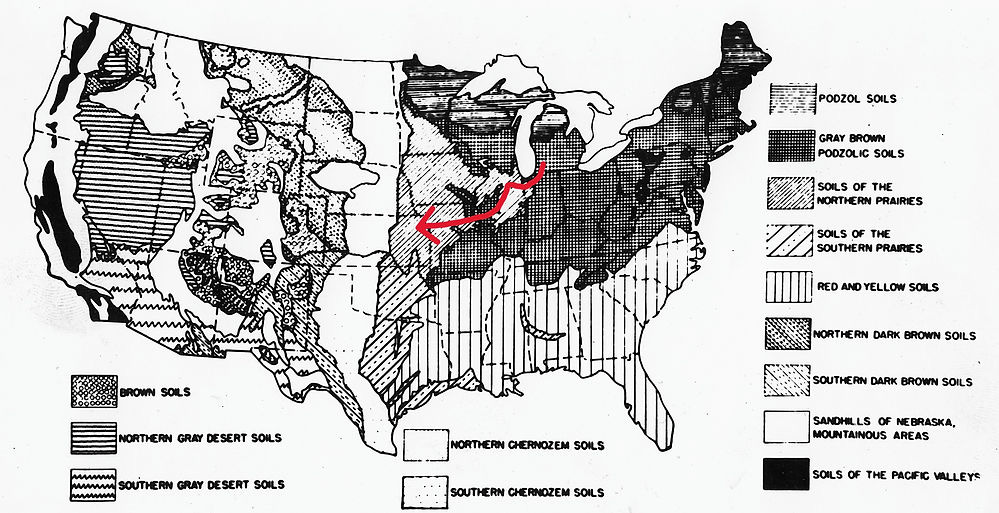
Albrecht loved maps. He had nearly a dozen maps of how different factors varied across the United States—rainfall, soil type, protein content of wheat, even radio reception. He showed slides of these maps whenever he gave a presentation and he reproduced them profusely in his published articles. While editing his papers, I’ve spent a lot of time looking at those maps. So I was excited when Acres asked me to speak at a conference in Hiawatha, Kansas. It was eleven-hour drive to get there from my home in Michigan, and most of the drive was through Illinois and Missouri. I didn’t have time to go down to Columbia, but I was still driving through the landscapes that shaped Albrecht’s theories of climate, soil development, and nutrition.
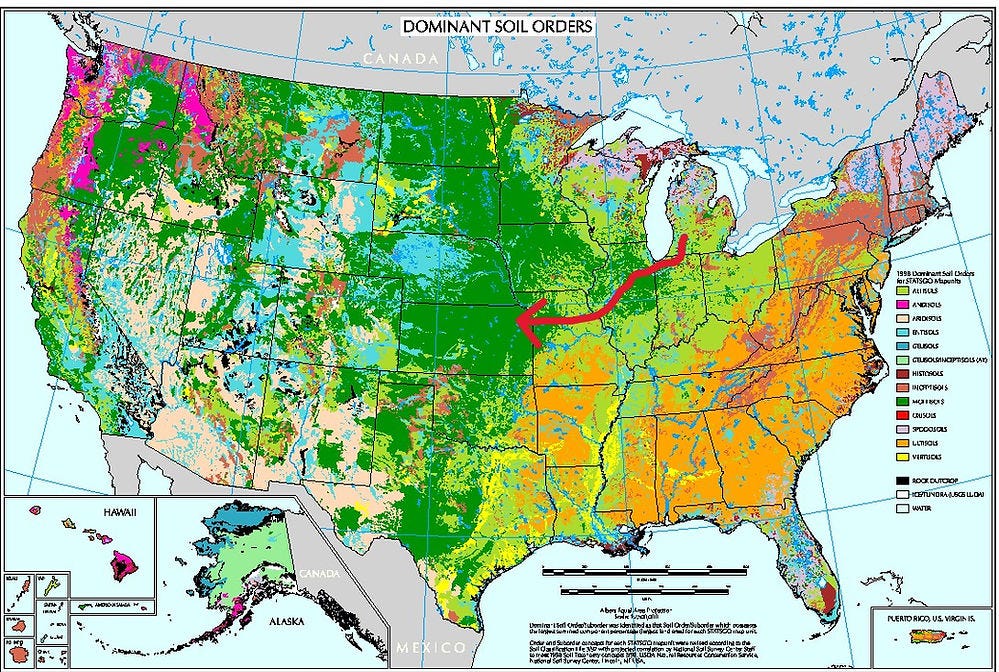
As a soil scientist, Albrecht was especially fascinated with soil types. On this trip I drove across two of the most fertile soil orders in the United States—the grayish-brownish alfisols in southern Michigan, northern Indiana, and eastern Missouri and the dark-brown mollisols in Illinois, western Missouri, and Kansas. Back in Albrecht’s day, the alfisols were called “gray-brown podzolic soils” and the mollisols were called “chernozems.” Alfisols form under hardwood forests; mollisols under tallgrass prairie.
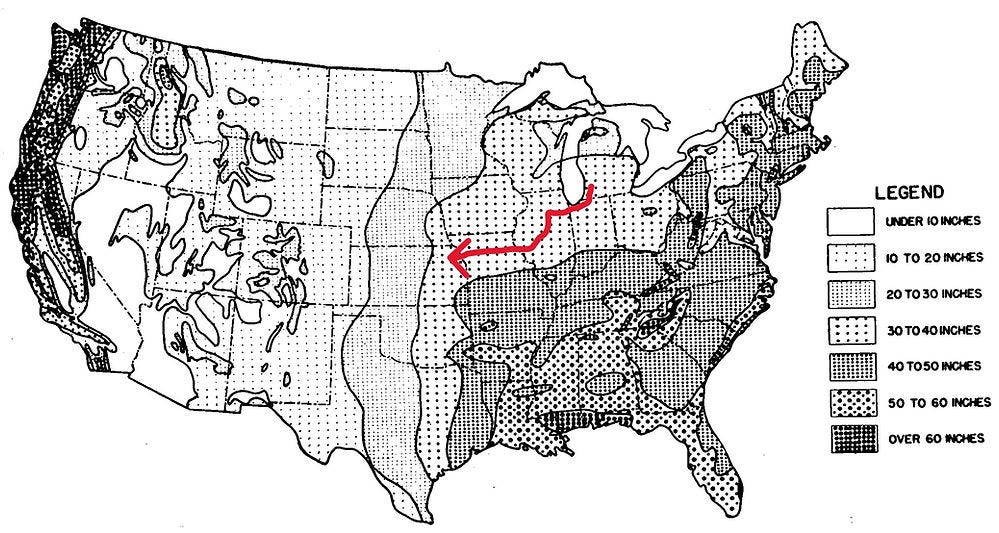
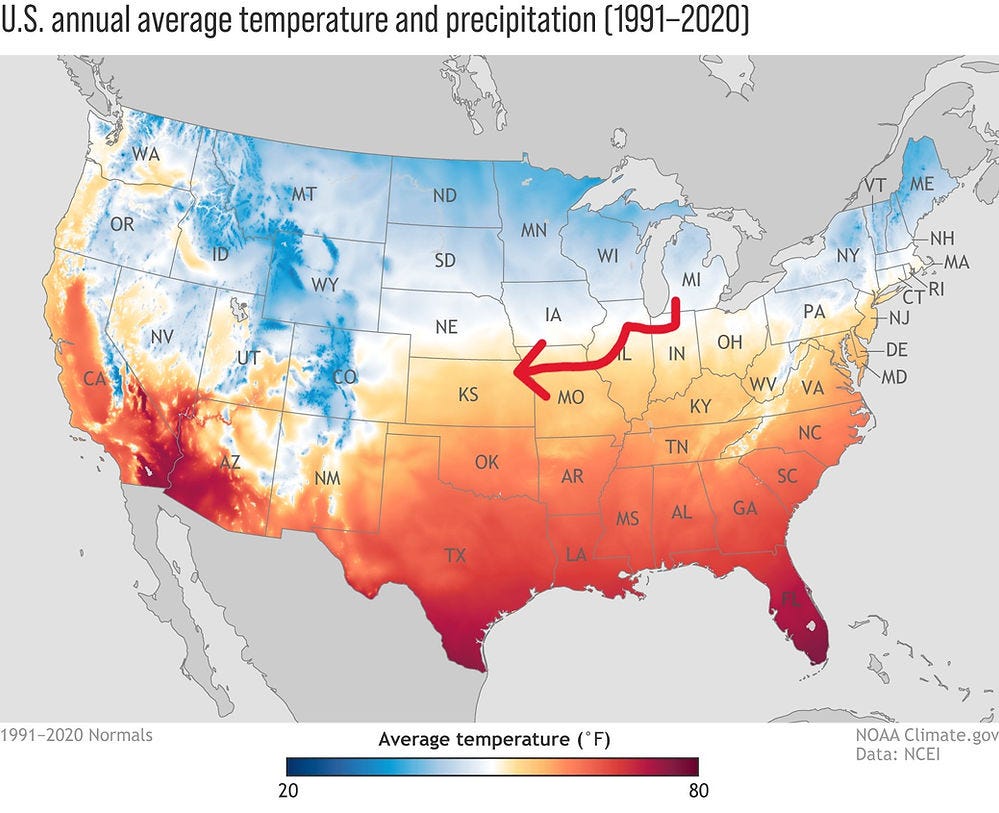
When I arrived in eastern Kansas, it looked fairly similar to the landscapes I’d driven through in Missouri and Illinois. As Albrecht’s precipitation map shows, the average rainfall in every region I drove through is between 30 and 40 inches. The temperature in eastern Kansas is warmer than Michigan—the farmer we visited, Jack Geiger, talked about planting oats in February, which we can’t do because the ground is still frozen.
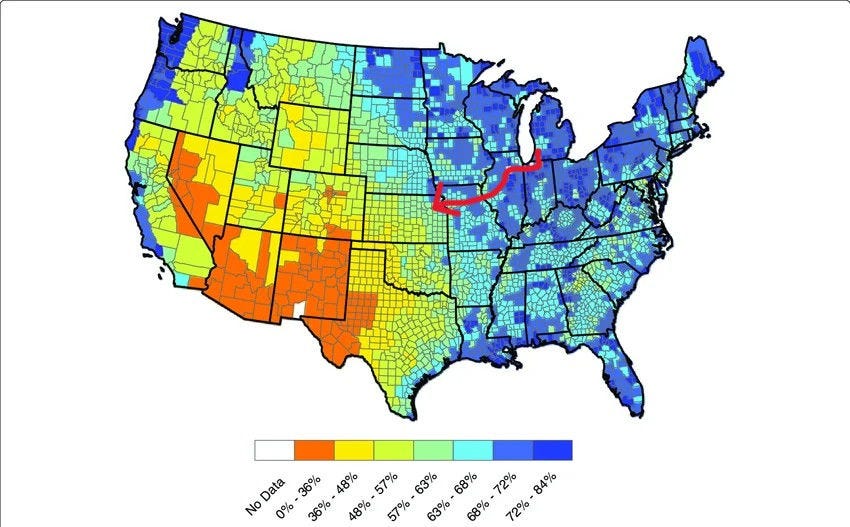
But Kansas felt different. It was far less humid than my home in Michigan, where a haze of water vapor hangs in the air on hot summer days. Albrecht didn’t usually talk about atmospheric humidity, but I wonder if it affects soil development. Another major difference that Albrecht didn’t map was the wind. It’s way windier in Kansas than Michigan. We only worry about water erosion; Jack Geiger explained that he has to protect his soil against wind erosion as well. Albrecht did mention wind as a soil formation agent, but he didn’t include any wind maps. Maybe that’s just because they weren’t available in the 1940s.
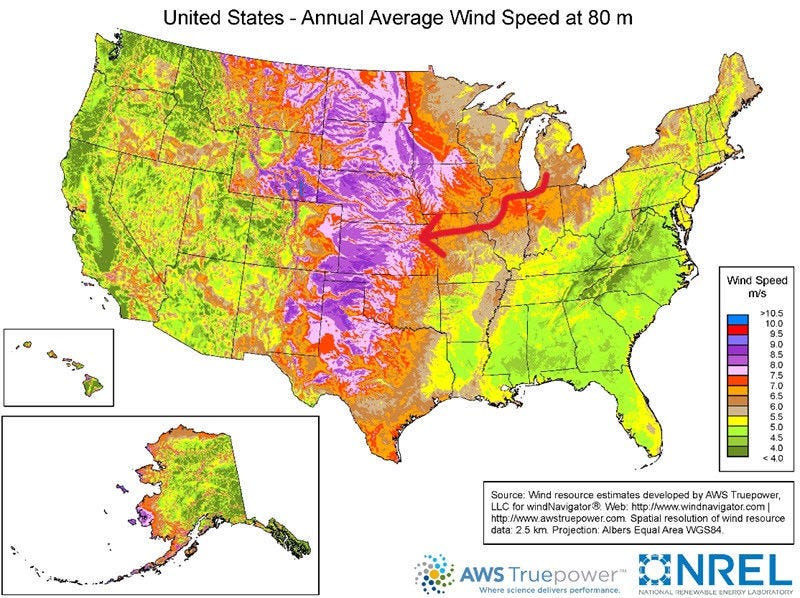
Looking at—and driving—these maps got me thinking about how the politicization of “climate change” has made it difficult to even use the word “climate” in the sense that Albrecht did. Technically, an increase in temperature doesn’t automatically mean that the climate is changing, because climate is also shaped by rainfall, soil type, humidity, wind, and other factors. The Plains are always going to have a different climate than Michigan, even if both get slightly warmer.
There’s a strong tendency today to blame every crop failure, every drought, every severe storm, every wildfire on climate change. But when those same types of natural disasters hit the same regions a hundred years ago, people like Albrecht didn’t blame the climate. They blamed climactically inappropriate farming methods, cropping systems, and settlement patterns. More importantly, they worked to adapt those systems to the climate—a strategy that’s even more important today.
It was a pleasure meeting you in Kansas! I appreciate the historical perspective concerning the politicization of 'climate', and whole heartily agree with the closing statements: "But when those same types of natural disasters hit the same regions a hundred years ago, people like Albrecht didn’t blame the climate. They blamed climactically inappropriate farming methods, cropping systems, and settlement patterns." Today there is a huge disconnect from context. People completely removed from the landscape, or more to the point, landcare, are making assumptions and policies without any idea of causation. Living in Kansas the past 20 -25 years, it's become clear to me, the windstorms, wildfires and droughts in the Great Plains are directly related to a complete breakdown of the water cycle due to excessive tilling, overgrazing and poor soil stewardship. Jack's farm is an exception. Yes, we change the climate...it's not entirely agriculture's fault (urban industrial smog is part of it), but it would be good to take seriously the correlation between conventional agricultural methods and the decreasing resilience of our soil ecology.
Re: "There’s a strong tendency today to blame every crop failure, every drought, every severe storm, every wildfire on climate change." I am not sure I can be clear what I am trying to say, but here goes: There's a big difference between climate and weather. Natural disasters happen 'all the time.' How we interpret things is the crux of the matter. There have been, to be sure, changes in weather patterns due to volcanic eruptions, and others made it possible to grow wheat in northern regions (or wine, or . . . ), or made it impossible. Like you, I find blaming climate change for just about anything (a small exaggeration on my part) is specious and unhelpful. But climate change can be accelerated by human actions, by poor land use or industrial activity or the unthought-of results of just so many people living in proximity of each other. But that does not mean that healthy farming practices can completely ameliorate the results of earth-wide trends that occur partly--at least--because of human activity.
All that said, I am encouraged again and again by stories of fruitful permaculture settlements in Jordan, by Mexican scrub turned into rangeland suitable for herbivores. Outside of starvation or migration, however, some great farming activities just don't work in some places for all sorts of reasons. Those of us in the Anglican tradition pray for 'seasonable weather'. I quote this a lot, but have yet to come up with a better prayer at the beginning of a growing year. (But please, not another year of drought, Lord, no matter what the cause.)